Neighborhood Guide
Azabudai / Toranomon
If you're arriving in Tokyo as a senior executive and someone has told you to "just look at what's newest and most central," this is almost certainly the area they meant. Azabudai Hills and Toranomon Hills are Mori Building's two most recent flagship developments, and together they've redefined what "central Tokyo" means for the top of the relocation market over the past few years. But the area is older and stranger than the glass towers suggest — this is a neighborhood where a 400-year-old shrine sits in the shadow of Japan's tallest building, and that contrast is worth understanding before you decide whether it's home.
The short version: this is engineered Tokyo — new, frictionless, and designed by people who thought about your commute, your dinner, and your kids' school before you arrived. What it isn't is flat, or quiet, or something you'll stumble into by accident. Read on if that trade-off sounds right for you.
The streets that actually organize the area
Two arterial roads define the neighborhood's geography: Sakurada-dori, the wide road that runs past Toranomon and up toward Kamiyacho, and Azabu-dori, which continues from there toward Roppongi. Azabudai Hills itself was built to connect the two — a new road called Sakura-asa-dori, literally combining the first characters of Sakurada and Azabu, now cuts through the development on a gentle slope. Before redevelopment, this whole stretch was a warren of narrow lanes and wood-frame houses; the slope and the curved low-rise "Garden Plaza" buildings (A through D) that now line it were deliberately designed to preserve some of that human scale rather than presenting a single monolithic block.
Along Sakura-asa-dori and through the central plaza, Azabudai Hills' landscaping includes a deliberate "cherry blossom gateway" — roughly 100 trees across ten different varieties, planted with staggered bloom times so that the flowering season stretches from February through April rather than peaking and vanishing in a single week, which is unusual for a Tokyo cherry blossom spot and worth knowing if you want a quieter, longer hanami than Naka-meguro's canal offers.
The view from the top
Mori JP Tower, Azabudai Hills' main tower, is currently Japan's tallest building at 325 meters — it overtook Osaka's Abeno Harukas shortly after completion. The 33rd-floor Sky Lobby used to be a free public observation deck, but since April 2024 it's accessible only to office tenants and to guests of the floor's restaurants and cafés — practically speaking, that means Dining 33, a French restaurant with floor-to-ceiling windows looking straight out at Tokyo Tower (dinner service puts the Tower's illumination directly in your sightline, which makes it a natural pick for an anniversary or a client dinner), and the more casual Sky Room Cafe & Bar, where a seat and one drink for around ¥1,100 is the cheapest way to get up there. Night-view enthusiasts single this floor out specifically because nothing blocks the sightline to Tokyo Tower at close range — arguably a better angle on the Tower than you get from Roppongi Hills' Mori Tower observation deck.
What survived the redevelopment
For a client who wants to know whether there's any "real Tokyo" left here, the honest answer is: yes, in pockets, and they're worth seeking out precisely because they're easy to miss.
Nishikubo Hachiman Shrine sits essentially inside the development now — a pedestrian bridge between two of the Garden Plaza buildings connects directly to its grounds, which makes for one of the odder juxtapositions in the neighborhood: a centuries-old Shinto shrine reached by a glass-and-steel walkway between luxury retail buildings.
Across Sakurada-dori from the main development, Daiyo-ji — a Jodo-shu temple founded in 1611, displaced by the redevelopment and rebuilt within Azabudai Hills' own C-4 block in 2023 — is a small, quiet counterpoint to the retail around it: proof that even the newest block of the development had to make room for something that predates it by four centuries. A short walk further sits Oranda Hills, an earlier and much lower-key Mori Building project from before the "Hills" branding became a luxury signifier — worth a mention mainly because it shows how much the company's ambitions (and the neighborhood's prices) have grown over twenty years.
A few minutes from Toranomon Hills, The Okura Tokyo is the other kind of institution entirely — opened in 1962, rebuilt in 2019 while deliberately preserving its mid-century lobby design. What that history means day to day: its Lobby Bar (still called Highlander by most regulars) is a Scotch specialist with a clientele that skews notably older and more established than anywhere else in the neighborhood. If Andaz's Rooftop Bar is where you take a client for the view, The Okura is where you take one to signal that you understand Tokyo's older institutions — a genuinely useful distinction to have in your back pocket once you're entertaining here regularly.
For families, Minato Science Museum, a short walk from Toranomon Hills Station, opened in 2020 and pairs hands-on science exhibits themed around the neighborhood itself (a large-scale model of Minato Ward's infrastructure and geography) with a planetarium and an attached, free Meteorological Science Museum run by the Japan Meteorological Agency next door. Reviews are consistently warm but modest about scale — most visitors describe it as compact rather than a full day out, better suited to a couple of hours before or after lunch than as a standalone destination, with the planetarium generally rated the highlight.
On the more mundane but more decisive question — where the weekly food shop actually happens — Azabudai Hills Market, on the basement floor of Garden Plaza C, opened in 2024 with roughly 30 specialty vendors covering fresh produce, meat, fish, prepared food, and bakery. It's genuinely good and genuinely expensive; residents describe it as closer to a high-end food hall than a neighborhood supermarket, and it's common to supplement it with a trip to a regular supermarket in Azabu-Juban or Roppongi for everyday basics. For families with young children, The British School in Tokyo's Azabudai Hills Campus sits inside the development itself, at 1-3-3 Azabudai — Nursery through Year 6, with the Secondary campus across town in Sangenjaya — which is very possibly the single biggest reason a family chooses this neighborhood over a comparable one elsewhere in central Tokyo. See our international schools guide for how it compares to other options across the city.
No discussion of this neighborhood's expat life is complete without the Tokyo American Club — founded in 1928, now with roughly 4,000–4,500 member households from over 60 countries, and for a certain generation of Tokyo-based expat executives, quietly one of the city's most efficient professional and social networks. It isn't a place you can walk into (entrance fee in the range of ¥4 million, plus an English-language interview), but clients relocating with a multi-year mandate sometimes ask about it directly, and it's worth knowing it sits right here in Azabudai, beside the Russian Embassy, rather than assuming it's a Roppongi or Hiroo institution.
And for something considerably less exclusive but arguably more essentially Tokyo, Nodaiwa sits directly on Sakurada-dori, practically in Tokyo Tower's shadow — a unagi restaurant with roots back to the 1790s, housed in a relocated gassho-zukuri farmhouse from Hida-Takayama. It's the kind of old-Tokyo institution a client living in Azabudai Hills might walk straight past without realizing it predates the neighborhood by two centuries — worth pointing out for that reason alone, and worth booking ahead rather than walking in.
Atago: the hill that explains the neighborhood
The map makes Azabudai and Toranomon look flat. It isn't — and Atago Shrine, sitting on the highest natural hill in central Tokyo, is the fastest way to understand why. If you're seriously considering a lease here, walk up the Shusse no Ishidan, the 86-step staircase to the shrine, once before you sign — it takes about ninety seconds and tells you more about the daily reality of this neighborhood's gradient than any floor plan will. (There's an elevator on the Jikei University side if the stairs aren't for you, which is also worth knowing: a resident who can't manage 86 steps has options here, not just a workaround.) The shrine itself dates to 1603, founded to protect old Edo from fire, and the grounds are quiet and genuinely green — cherry blossoms in spring, color in autumn — which makes it a good five-minute reset if your apartment or office is nearby. The NHK Museum of Broadcasting next door is a reasonable rainy-Sunday stop with young kids, free admission and hands-on exhibits, though we wouldn't build a special trip around it.
Just south, along Atagoshita-dori, a small cluster of temples — most notably Seishoji, a Zen temple with a genuinely peaceful courtyard — breaks up the office towers. It's less a destination than a reminder that the area's texture didn't start in 2023; worth a five-minute detour if you're walking through anyway, not a special trip.
Toranomon's other side: shrines, alleys, and a proper night out
Toward Toranomon Hills itself, Toranomon Kotohira-gu is a shrine known specifically for matchmaking and relationship blessings — an unusual thing to find embedded in a business district, and a useful bit of local color for a client who wants to understand the neighborhood as more than office towers. For an evening out, Toranomon Yokocho, a modern take on the postwar yokocho alley concept, clusters a run of small bars and izakaya near Toranomon Hills Station — the kind of easy, unpretentious "hop from one counter to the next" evening that's harder to find amid the more formal dining inside the Hills complexes themselves.
For something considerably more polished, the Rooftop Bar at Andaz Tokyo occupies the 52nd floor of Toranomon Hills Mori Tower — floor-to-ceiling views toward Tokyo Bay and Odaiba, an indoor bar plus a terrace (a cover charge applies for terrace seating after 8pm, waived for hotel guests), and seasonal cocktails built around Japanese ingredients. It's the natural answer for entertaining a client or celebrating a signed lease, and a genuinely good orientation point for anyone new to the city — one drink up there makes the neighborhood's geography click into place in a way a map doesn't. The adjoining the SUSHI counter, tucked into the same floor, is worth knowing about separately as a quieter, counter-only option for a more serious dinner.
A short walk away, The Tokyo EDITION, Toranomon — opened in 2020, designed by Kengo Kuma, with every one of its 206 rooms starting from the 31st floor — is the third option in this neighborhood's small cluster of destination hotels, and it's worth knowing which is which before you're the one making the reservation: The Okura for old-guard formality, Andaz's Rooftop Bar for the single best view, and EDITION's Gold Bar and Blue Room for a younger, design-forward crowd that skews more fashion and nightlife than either of the other two. All three are within a few minutes' walk of each other, which is a genuinely useful thing to know when a client asks where to take an important dinner and the answer depends entirely on who's coming.
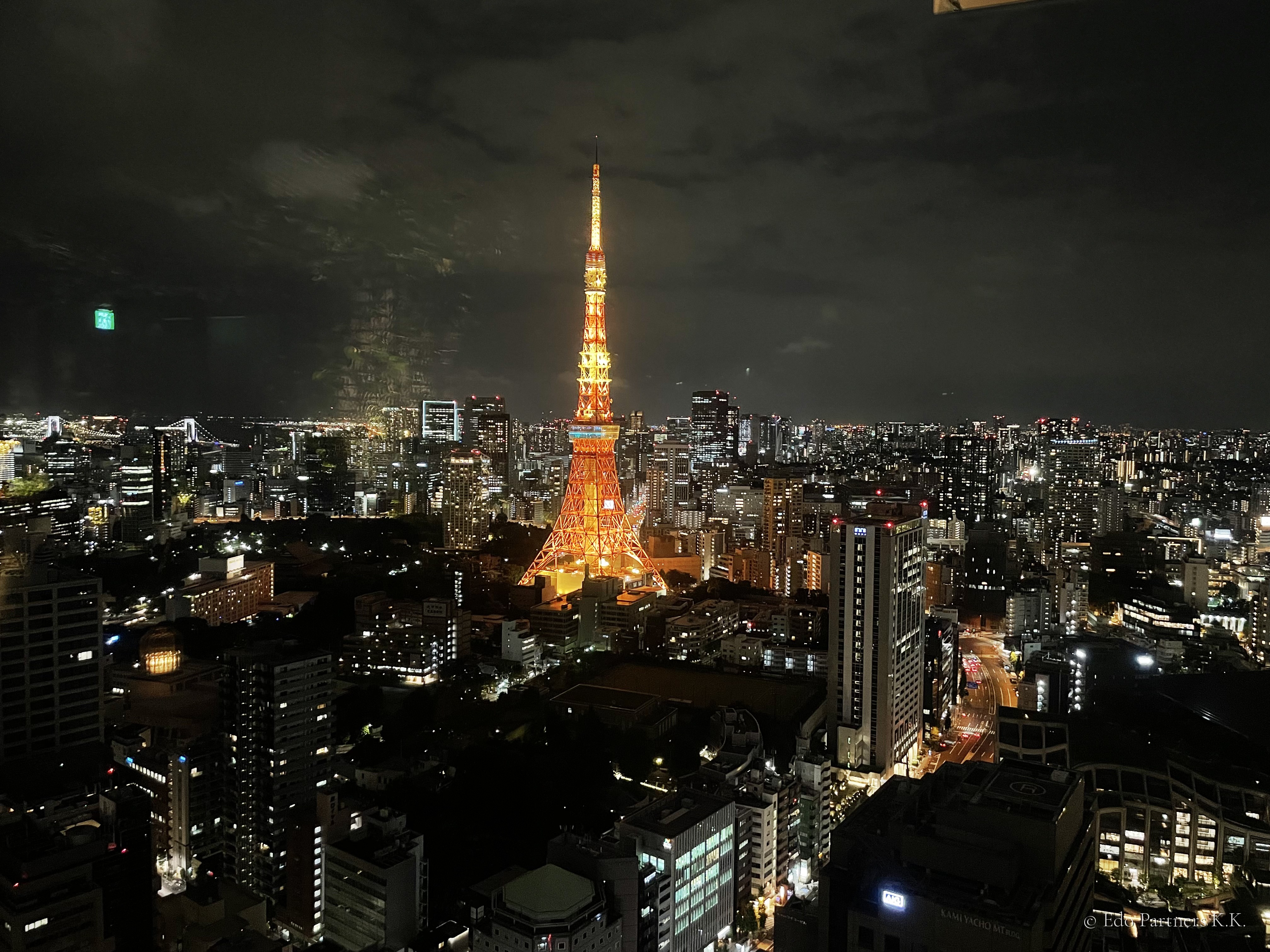
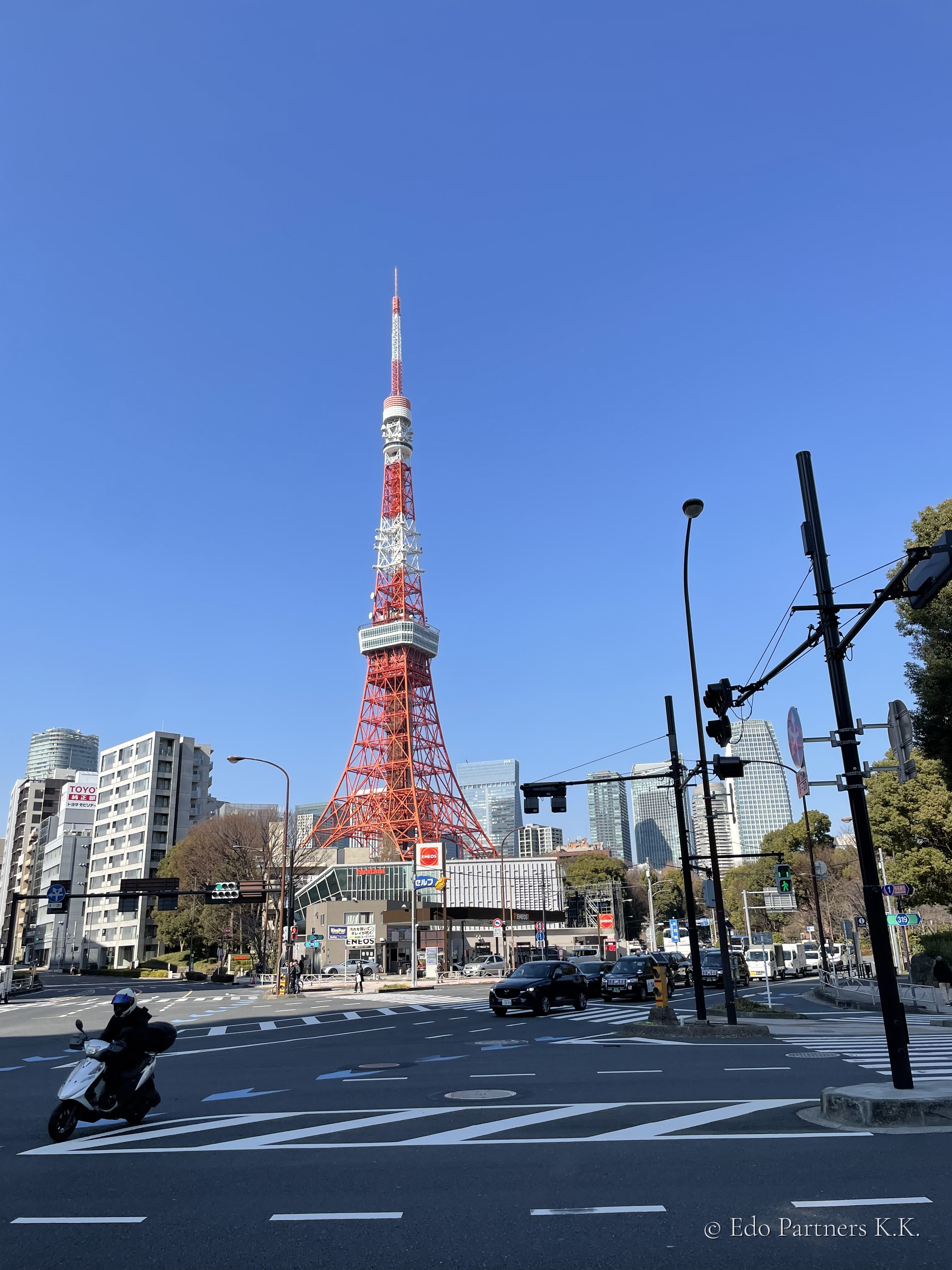
If you have young kids, Shiba Park is where a lot of Sunday afternoons here actually happen — a short walk south, with Tokyo Tower rising above the treeline the whole way, enough open lawn for a kid to run without a ball rolling into traffic, and Atago Shrine close enough to add on if everyone still has energy. It's not a destination park the way Yoyogi is; it's the neighborhood's answer to "we need to get the kids outside for an hour," which is a different and more useful thing to know. Tokyo Tower itself functions less as a place you visit and more as a fixed point you orient by — it turns up between buildings often enough that you stop noticing it, until a visitor points it out and you realize how used to it you've become.
Getting around
Toranomon Hills Station opened in 2020 specifically to serve the development — which matters practically, not just historically, because it changed the area's commute math considerably: Kamiyacho and Roppongi-itchome are both within walking distance too, so you're rarely locked into one line if there's a delay. Azabudai Hills is directly connected underground to Kamiyacho Station via its "Central Walk," meaning you can move between the two developments and the subway without going outside at all — a genuinely daily-life detail in Tokyo's summer humidity, not a trivia point. Haneda Airport is a straightforward 25–30 minute ride, useful if you're traveling frequently.
Who this suits, and who it doesn't
A common surprise for first-time clients here: the area feels smaller and more walkable once you've lived in it for a few weeks than it does on a first tour, precisely because so much of daily life happens underground or across the pedestrian bridges rather than at street level. That takes some adjustment.
Best for:
- Senior executives or couples relocating on a tight timeline, for whom minimizing friction matters more than neighborhood character
- Anyone whose role means visibility and discretion both matter — the buildings are designed for exactly that combination
- Families who want a five-minute walk from home to a clinic and an international school, and don't mind that "outside" mostly means a landscaped plaza rather than a street
Less ideal for:
- Families who want their kids biking around a neighborhood with other kids on the street, rather than through a managed development
- Anyone on a budget that isn't essentially unlimited — this is among the most expensive residential real estate in Tokyo, full stop
- Clients who specifically want an aging shotengai shopping street and neighbors who've been there thirty years — this is deliberately built Tokyo, not organic Tokyo, even where it's preserved something old, and Yanesen is a better answer to that brief
The residences themselves
Mori Living operates the residential towers in both developments — Azabudai Hills Residence and Toranomon Hills Residential Tower — and each of which now has its own building page — Toranomon Hills Residential Tower, Azabudai Hills Residence B, and Atago Green Hills Forest Tower — with the other serviced apartment options in this neighborhood covered on our short-term housing page. In short: expect concierge service, direct building access to the retail and dining below, and pricing that reflects all of it. Minimum stays and exact unit availability change regularly enough that we'd rather confirm current numbers with you directly than publish a figure that's stale in three months — get in touch and we'll pull what's currently available.
TokyoExpat's Take
Azabudai / Toranomon
We place clients here when the brief is essentially "I want the least friction possible and money isn't the constraint." It's an excellent answer to that brief. It's a less good answer if what someone actually wants — even if they haven't said it yet — is to feel like they live in Tokyo rather than above it. Part of our job in the first conversation is figuring out which of those two things a client actually means. Our own habit, when we're showing this area to a client for the first time, is to walk them up the Shusse no Ishidan rather than take the elevator — it takes ninety extra seconds and tells you more about the neighborhood than any brochure does.